Rohit Baniwal, writer
Brief news
- Slovakia, known as the “Detroit of Europe,” is highly reliant on its automotive sector, which significantly contributes to its U.S. exports and employment.
- President-elect Trump’s proposed tariffs on imports could threaten Slovakia’s automotive industry, which accounts for 74% of its total exports to the U.S.
- European leaders, while relieved by the absence of immediate tariffs on Europe, remain concerned about potential future impacts on the automotive sector, particularly in Slovakia and Germany.
Detailed news
It appears that a small landlocked nation in the heart of Europe is uniquely vulnerable to President-elect Donald Trump’s “America First” economic agenda.
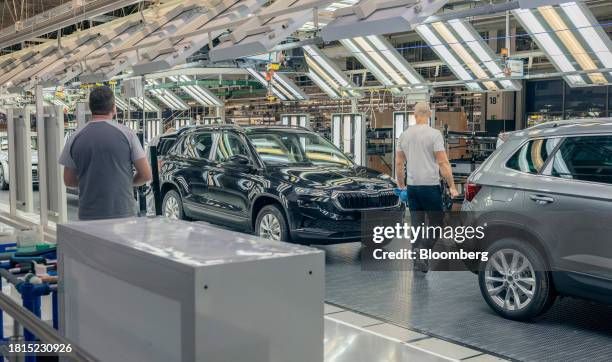
Slovakia is the world’s largest producer of automobiles per capita, earning it the moniker “Detroit of Europe” as a result of its flourishing automotive sector.
The central European nation’s status as a global leader in vehicle production is at risk of being tarnished by Trump’s promise to impose a blanket 10% or 20% tariff on all goods entering the United States.
In one of his first acts as president, the incoming U.S. president on Monday pledged to impose new tariffs on China, Canada, and Mexico. The measures consist of a 25% tariff on all commodities from Canada and Mexico and an additional 10% tariff on all Chinese products entering the United States.
The absence of any reference to Europe in Trump’s initial tariff announcement will be regarded as a positive development by European Union policymakers. However, the 27-nation bloc is likely to be concerned that Trump will eventually focus on the auto sector in the region.
This is a significant issue for Slovakia. The country, which has a population of 5.5 million, is severely dependent on U.S. trade. Autos account for a significant portion of its U.S. exports, and the sector indirectly employs over 250,000 individuals.
“Slovakia has become the Detroit of Europe,” stated Vladimir Vaňo, chief economist at Globsec, a think center located in Bratislava, Slovakia, in a telephone conversation with CNBC.
“In 1990, Slovakia manufactured precisely zero automobiles subsequent to the collapse of the Iron Curtain.” However, it was particularly robust in the field of special manufacturing, which is a polite term for the production of armored vehicles, tanks, and other similar items in our local vernacular,” Vaňo stated.
According to Vaňo, Volkswagen, the German manufacturer, was the first to recognize Slovakia’s potential for engineering and manufacturing. Volkswagen initially focused on the assembly of gearing boxes before expanding to the production of complete vehicles.
Stellantis-owned Peugeot, Hyundai Motor’s Kia, and Tata’s Jaguar Land Rover have all established manufacturing centers in the country in addition to Volkswagen’s plant in Bratislava.
Volvo of Sweden declared in 2022 that it intends to establish a climate-neutral factory in eastern Slovakia by 2026, making it the fifth automobile manufacturer to operate in the country. Volvo stated that the 1.2 billion-euro ($1.26 billion) plant will exclusively manufacture electric vehicles.
Globsec’s Vaňo expressed concern regarding the potential impact of Trump tariffs on Slovakia, stating, “It is concerning.” However, it is a lame-duck, wait-and-see approach.
He also stated that Slovakia’s manufacturers have demonstrated a reputation for being adept at overcoming obstacles in the past, despite the fact that there is “very little” that they can do in the short term.
CNBC was unable to obtain a response from a spokesperson for Slovakia’s government right away.
Future Obstacles
Germany’s auto industry, which is currently experiencing a crisis, is expected to be particularly susceptible to tariffs imposed by the United States, in addition to Slovakia.
Europe’s largest economy is the region’s largest exporter of passenger cars to the United States, with 23 billion euros in exports last year, according to data compiled by Eurostat and ING Research. That is equivalent to 15% of Germany’s total exports to the United States.
Rico Luman, senior sector economist for transport and logistics at Dutch bank ING, stated that the potential for U.S. tariffs on European automobiles is likely to exacerbate the already dire situation in Germany.
“It is the center of the manufacturing sector, correct?” In a video call with CNBC, Luman disclosed the information. “Consequently, the automotive industry is ultimately connected to the steel and chemical industries, thereby involving the entire supply chain.”
In 2023, Slovakia and Sweden were the joint-third-largest exporters of passenger cars to the United States in Europe, with a total of 4 billion euros in exports.
It is important to note, however, that Slovakia’s passenger car exports comprise nearly 74% of its total export package to the United States, rendering the country highly vulnerable to the imminent prospect of Trump tariffs.
Arushi Kotecha, automotive analyst at the Economist Intelligence Unit, informed CNBC via video call that Slovakia has achieved impressive results in auto production thus far. However, she also acknowledged that the country is currently confronted with certain obstacles.
China is the source of one of those issues.
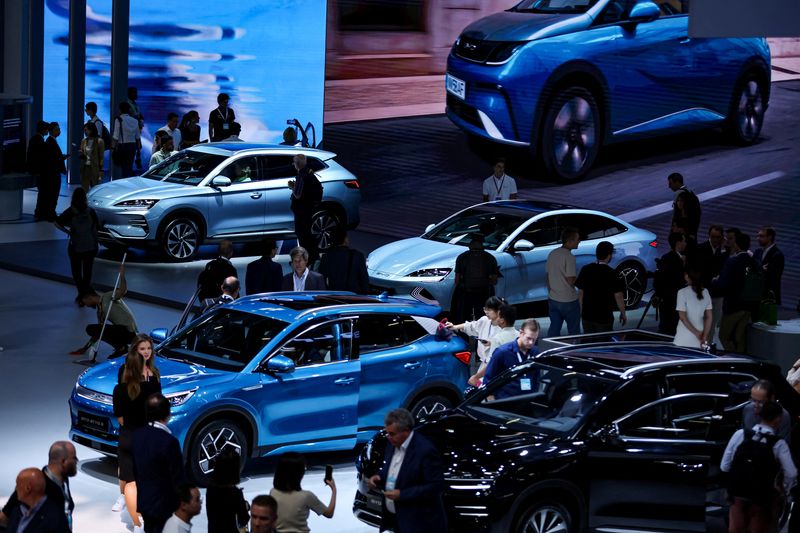
Kotecha of the EIU stated that European legislators were attempting to maintain their position by restricting the extent to which Chinese automakers, including BYD, could enter the regional market in terms of investment and sales.
“There is at least some degree of certainty regarding the Chinese, as the tariffs have been implemented and China has responded accordingly.” Kotecha stated, “The China portion of the project is complete; however, there is some uncertainty associated with the Trump election.”
“The issue with Trump is that he frequently issues threats, but his ability to execute them is inconsistent.”
When questioned about the potential for U.S. tariffs, a spokesperson for the European Commission, the EU’s executive branch, directed CNBC to a statement issued by European Commission President Ursula von der Leyen, in which she congratulated Trump on his election victory.
Von der Leyen declared in a statement on November 6 that the European Union and the United States are more than mere allies.
“Let us collaborate to establish a transatlantic partnership that consistently benefits our citizens.” “The dynamism and stability of our economic relationship are essential for the millions of jobs and billions in trade and investment on both sides of the Atlantic,” she continued.
Source : CNBC news