Anamika Dey, editor
After the most consequential US-Iran diplomatic encounter in nearly half a century, Vice President JD Vance boarded Air Force Two without an agreement — leaving a fragile ceasefire, a blocked waterway, and a region in limbo.
Key points
- US Iran peace talks in Islamabad ended after 21 hours with no agreement on Sunday
- Iran refused to commit to forgoing nuclear weapons — Washington’s core demand
- The talks were the first direct US-Iran engagement since the 1979 Islamic Revolution
- Vance left a “final and best offer” on the table; Iran called US demands “excessive.
- The fragile two-week ceasefire and Strait of Hormuz access remain deeply uncertain
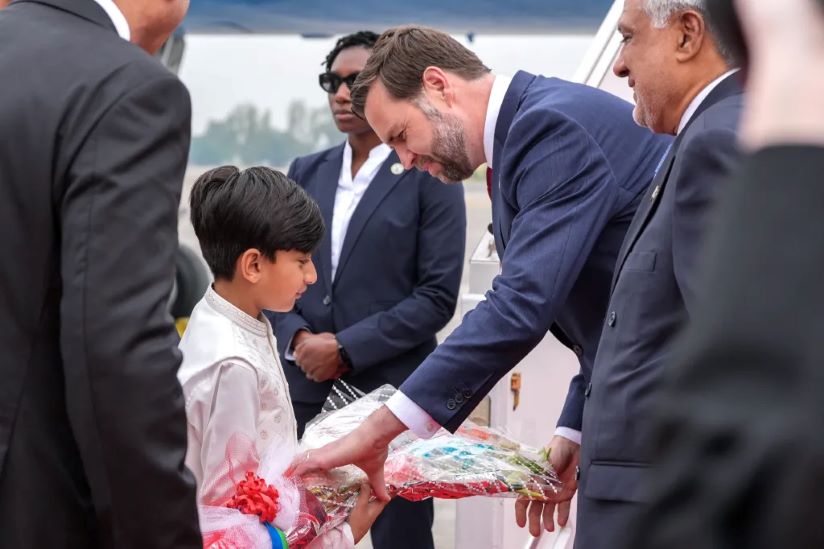
It was supposed to be the moment the world had been waiting for — the first face-to-face conversation between American and Iranian officials in nearly half a century. Instead, after an exhausting marathon of US Iran peace talks in Islamabad, Vice President JD Vance boarded Air Force Two on Sunday morning with nothing to show for it but a thumbs-up gesture and a parting warning.
The United States and Iran failed to reach an agreement after a day of highly anticipated face-to-face US Iran peace talks, with Vance announcing the breakdown in Islamabad on Sunday.
“The bad news is that we have not reached an agreement. And I think that’s bad news for Iran much more than it’s bad news for the U.S. — they have chosen not to accept our terms.”
— Vice President JD Vance, press conference in Islamabad, April 12, 2026
A city on lockdown, a world watching
Islamabad, a city of over two million people, was locked down for the occasion — thousands of paramilitary personnel and army troops lined the streets around the luxury Serena Hotel where the US Iran peace talks were held. Billboards bearing doves and the flags of the U.S., Iran, and Pakistan decorated the convention center where journalists waited anxiously — sipping tea and coffee to the sound of live musicians.
The weight of the moment was impossible to ignore. These US Iran peace talks were the first face-to-face diplomatic engagement between Washington and Tehran since 2015 — and the highest-level direct meeting since the Islamic Revolution of 1979.
Vance was joined by special envoy Steve Witkoff and President Trump’s son-in-law Jared Kushner — both veterans of past U.S. negotiations over Gaza and Ukraine. The Iranian delegation was led by Parliament Speaker Mohammad Bagher Ghalibaf.
Twenty-one hours of “mood swings”
The US Iran peace talks in Islamabad stretched far beyond expectation, running through the night from Saturday into Sunday morning. “There were mood swings from the two sides and the temperature went up and down during the meeting,” one Pakistani source told Reuters in reference to the first round of talks.
But the two sides came in with fundamentally different mindsets. According to CNN’s analysis from Islamabad, the US appeared to be seeking a relatively quick resolution following a two-week ceasefire, while Tehran typically moves much slower — negotiating over the long term. The respective delegations were simply too far apart, not just in substance, but in style and temperament.
The Iranian delegation arrived with a powerful visual statement — dressed entirely in black, mourning the late Supreme Leader Ayatollah Ali Khamenei and others killed in the war. They also carried shoes and bags belonging to students killed during a U.S. bombing of a school next to a military compound — an act the Pentagon says is still under investigation.
The nuclear red line that broke the US Iran talks
The central sticking point in the US Iran peace talks was stark and non-negotiable, at least from Washington’s perspective: Iran’s nuclear program.
“The simple fact is that we need to see an affirmative commitment that they will not seek a nuclear weapon, and they will not seek the tools that would enable them to quickly achieve a nuclear weapon,” Vance said when pressed on what caused the US Iran talks to collapse.
Before departing for Islamabad, President Trump had already telegraphed where his red line was. “No nuclear weapon. That’s 99% of it,” he told reporters. Trump had also previously said the goals of the war with Iran included destroying its military capabilities and regime change — neither of which have been achieved.
Iran, however, refused to budge. Iranian state broadcaster IRIB said on Telegram that after 21 hours of US Iran talks and diplomatic efforts, “the excessive demands by America prevented any agreement.” Iran’s foreign ministry spokesperson Esmaeil Baqaei said there was a “gap in viewpoints” on key issues, pointing specifically to disagreement on “two or three key matters.” He also criticized Washington, saying the success of diplomacy depends on both sides acting in good faith and “refraining from excessive demands.”
Iran’s Parliamentary Speaker Ghalibaf went further, blaming the US entirely for the failure of the US Iran peace talks, saying the American side had failed to earn Tehran’s trust — particularly given that a previous round of nuclear negotiations had reportedly been progressing before unexpected military strikes began.
Strait of Hormuz: the other major fault line
Beyond the nuclear question, the Strait of Hormuz loomed large over the US Iran peace talks. The strategic waterway — through which roughly 20% of the world’s oil passes — has been effectively sealed since the war began six weeks ago, snarling global supply chains and pushing energy prices sharply higher.
Iran’s foreign ministry acknowledged the strait was among the central topics discussed in the US Iran talks in Islamabad, alongside nuclear issues, war reparations, sanctions relief, and a comprehensive ceasefire.
In a show of force during the US Iran peace talks, two U.S. Navy guided-missile destroyers transited through the Strait of Hormuz on Saturday — the first American warships to do so since the start of the conflict. U.S. Central Command said it had also begun setting conditions to clear Iranian sea mines planted throughout the waterway.
A door left slightly open
Despite the collapse of the US Iran peace talks, neither side completely slammed the door shut on future diplomacy.
Vance, standing at a podium alongside Witkoff and Kushner, left open the possibility that a deal could still be reached. “We leave here with a very simple proposal — a method of understanding that is our final and best offer. We’ll see if the Iranians accept it,” he said.
Iran’s foreign ministry spokesperson struck a measured note in response, saying “diplomacy never comes to an end” — even as Iranian state media reported that Tehran currently has no plans for another round of formal US Iran negotiations.
Pakistan, which had worked for weeks to position itself as the trusted mediator for the US Iran peace talks, vowed to continue. “We hope that the two sides continue with a positive spirit to achieve durable peace and prosperity for the entire region and beyond,” Foreign Minister Ishaq Dar said after the talks concluded.
What comes next for the US Iran conflict?
The failure of the US Iran peace talks raises urgent questions about the fragile ceasefire now hanging by a thread. Without a commitment from Iran to reopen the Strait of Hormuz, global energy supplies will continue to be throttled.
The status of the two-week ceasefire is now deeply uncertain. Vance did not indicate what would happen once the ceasefire period expired, or whether military action could resume. As CNN noted from Islamabad, Trump previously warned that Iran’s “whole civilization will die” if its leaders failed to reach a deal — but it is not clear he has the appetite to resume a war that has grown deeply unpopular among Americans, and which he has claimed the U.S. has already won.
Meanwhile, as the US Iran peace talks faltered in Islamabad, deadly Israeli airstrikes on southern Lebanon continued overnight — a grim reminder that beyond the negotiating table, the war rages on. Israel’s Prime Minister Benjamin Netanyahu said plainly: “Israel under my leadership will continue to fight Iran’s terror regime and its proxies.”
And so the world’s most consequential diplomatic gambit of 2026 ends — not with a handshake, but with Vance giving a thumbs-up at the top of the Air Force Two stairs, and a region left wondering what comes next for the US Iran war.