
Rohit Baniwal, writer
By TechSun News Desk | techsunnews.com | July 10, 2026 | Tech / Autos / Explainers | 6 min read 🚕
This week, Waymo announced it’s bringing driverless rides to San Diego, Las Vegas, Tampa, and Denver — four cities in a single announcement. No driver. No safety monitor. An empty front seat, and a car that picks you up, navigates traffic, and drops you off on its own. (Source: CNBC)
If you live in one of the 14+ US cities where these services now operate, a robotaxi isn’t science fiction. It’s an option in an app, sitting right next to Uber.
And yet most people still can’t quite explain what a robotaxi actually is, how the car sees the road, or why Waymo keeps pulling ahead of Tesla despite Elon Musk’s years of promises. Here’s how robotaxis work, why they’re expanding, and what it means for everyday drivers.
What Is a Robotaxi, Exactly?
A robotaxi is a ride-hailing taxi with no human driver. You order it through an app, exactly like an Uber. A car arrives, you get in the back seat, and software drives you to your destination. There is nobody behind the wheel — in most cases, there’s nobody in the front seats at all.
The industry’s technical term is a Level 4 autonomous vehicle. The levels run from 0 to 5: Level 2 is driver assistance (the car helps, but a human must supervise constantly — this is what Tesla’s Autopilot and most ‘self-driving’ features in consumer cars actually are). Level 4 means the car handles everything itself within a defined area, with no human needed. Level 5 — a car that can drive anywhere on Earth in any conditions — doesn’t exist yet.
That phrase ‘defined area’ matters. Robotaxis operate inside a geofence — a mapped boundary the company has tested extensively. Inside it, the car is on its own. Outside it, the service simply won’t take you. This is why robotaxis launch city by city rather than everywhere at once.
How Does a Robotaxi Actually Work?
A robotaxi drives using three things working together: sensors, maps, and AI.
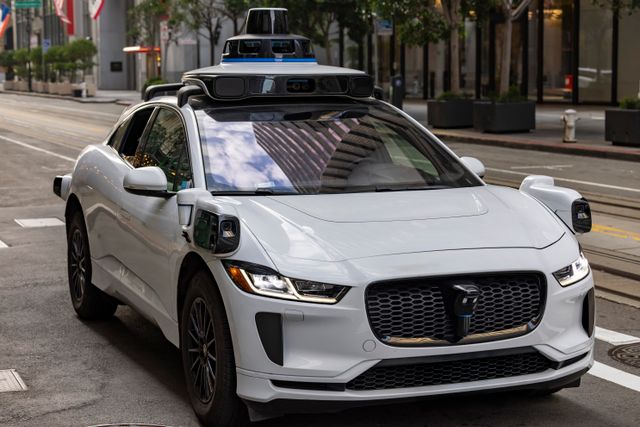
Sensors are the eyes. Waymo’s vehicles carry lidar (spinning lasers that build a 3D picture of everything around the car, accurate to centimetres), radar (which sees through rain and fog), and cameras (which read traffic lights, signs, and lane markings). Tesla takes a different approach — cameras only, no lidar — betting that vision plus AI is enough, the way a human drives with just two eyes. That single engineering disagreement is one of the deepest divides in the entire industry.
Maps are the memory. Before launching in a city, companies like Waymo drive it for months, building high-definition maps that record every lane, kerb, traffic light, and school zone. The car isn’t discovering the city in real time — it’s comparing what its sensors see against a map it already knows.
AI is the judgement. A neural network — the same fundamental technology behind ChatGPT, which we broke down in our AI terms explained guide — takes the sensor data and decides, many times per second, what to do next. Slow down for the cyclist. Yield to the ambulance. Wait for the pedestrian who looks like they might cross. All of this runs on specialised onboard chips — the same GPU and AI processor technology powering the rest of the AI boom, packed into the boot of a car.
Waymo vs Tesla — Where the Race Actually Stands
Ask a Tesla fan and a Waymo rider who’s winning, and you’ll get two completely different answers. Here’s what the verifiable numbers say as of July 2026.
Waymo — owned by Google’s parent company Alphabet — has been working on self-driving since 2009 and is the clear operational leader. Its driverless cars carry paying public passengers in more than 10 cities, including Phoenix, San Francisco, Los Angeles, Austin, Miami, Dallas, Houston, San Antonio, Orlando, and Atlanta — with San Diego, Las Vegas, Tampa, and Denver now being added. The fleet stands at roughly 4,000 vehicles, and the company is targeting more than one million weekly trips across 20+ cities by the end of 2026, plus London as its first international market. (Source: Axios)
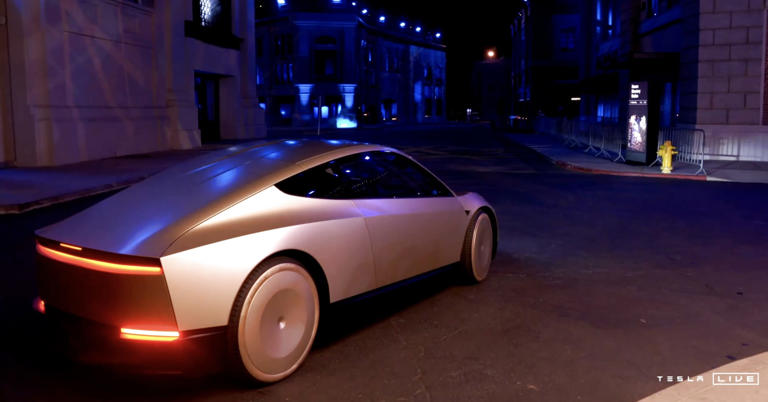
Tesla launched its paid robotaxi service in Austin in June 2025 and has since expanded to the Bay Area, Dallas, and Houston, with more Texas and Florida cities announced. But the picture on scale is genuinely disputed. Tesla-friendly trackers report a fast-growing service covering hundreds of square miles. A Reuters investigation in May 2026 found something much smaller — a handful of driverless vehicles in the newer cities and hours-long wait times. In California, Tesla’s cars still legally require a safety driver. Musk previously predicted robotaxis would serve half the US population by the end of 2025; that did not happen. Tesla’s purpose-built Cybercab — a two-seater with no steering wheel — entered production this year and is central to its scaling plans.
Zoox, owned by Amazon, is the quiet third player — running free rides on the Las Vegas Strip in purpose-built pods with no front or back, and preparing public launches in Austin and Miami later this year.
Side-by-Side Comparison
| Waymo | Tesla | Zoox | |
| Owned by | Alphabet (Google) | Tesla | Amazon |
| Cities live | 14+ (10 public + 4 new) | Austin, Bay Area, Dallas, Houston | Las Vegas (limited) |
| Fleet size | ~4,000 vehicles | Disputed — est. 50–500+ | Small pilot fleet |
| Safety driver? | No — fully driverless | Mixed — removed in some Austin cars, required in CA | No, purpose-built pods |
| Sensors | Lidar + radar + cameras | Cameras only | Lidar + radar + cameras |
| How to ride | Waymo app | Tesla app | Zoox app (invite) |
Are Robotaxis Actually Safe?
Safety remains the biggest concern for most people — and the fair answer has two halves.
The case that they’re safer: Waymo has published peer-reviewed studies arguing its vehicles are involved in significantly fewer injury-causing crashes per mile than human drivers. Robotaxis don’t drink, don’t text, don’t get tired, and react faster than humans. Over tens of millions of driverless miles, the aggregate data has so far supported the claim that they’re safer than the average human driver on the same roads.
The case for caution: The past year has produced a genuine pattern of incidents. A Waymo passed a stopped school bus in Atlanta in October 2025. Texas regulators logged 19 illegal school bus passings in December. In January 2026, a Waymo struck a child at low speed near a Santa Monica elementary school. In June, the company recalled 3,900 robotaxis after vehicles drove into construction zones. And this week, the National Highway Traffic Safety Administration sent a letter to autonomous vehicle developers demanding they fix a pattern of vehicles interfering with first responders. (Source: CBT News)
Both halves are true at once. The technology appears statistically safer than human driving on average, while still failing in specific situations — school buses, construction zones, emergency scenes — that any human driver would handle instinctively. Regulators are now focused on exactly those edge cases.
Who Regulates These Things?
In the US, no single authority controls robotaxis — which explains a lot about how unevenly they’ve rolled out.
Federal level: The NHTSA sets vehicle safety standards and requires companies to report every crash involving an automated system under a standing order. It can investigate and force recalls — as it has with Waymo — but it doesn’t licence services.
State level: Each state decides whether driverless vehicles can operate commercially. Texas, Arizona, and Florida have been permissive, which is why robotaxi expansion keeps clustering there. California requires a longer permit process and, for Tesla, still mandates safety drivers.
City level: Local authorities control kerbs, airports, and event zones — and local opposition has real teeth. Public pushback in some cities has delayed or reshaped launches.
If you followed our coverage of how Washington handled frontier AI models this year, the pattern will feel familiar: the technology is moving faster than the rulebook, and regulators are writing the playbook in real time.
Where Can You Ride One Today?
Available to the public now (Waymo): Phoenix, San Francisco Bay Area, Los Angeles, Austin, Miami, Dallas, Houston, San Antonio, Orlando, Atlanta — download the Waymo app and request a ride like any taxi.
Coming by end of 2026 (Waymo): San Diego, Las Vegas, Tampa, Denver — currently employee-only, opening to the public on a rolling invitation basis.
Tesla: Austin and parts of the Bay Area, Dallas, and Houston via the Tesla app, with availability and wait times varying considerably by city.
Zoox: Free rides on the Las Vegas Strip, limited pick-up points.
Outside the US: China is the other major robotaxi market — Baidu’s Apollo Go and WeRide operate at scale in several Chinese cities. Waymo’s planned London launch would be the first major Western expansion outside America.
Why It Matters for Ordinary People
Cheaper rides are the obvious promise — a robotaxi has no driver to pay, and in early price comparisons, some robotaxi rides already undercut human-driven alternatives on the same routes. Whether those savings hold as companies chase profitability is an open question.
The bigger shifts are slower. If robotaxis keep scaling, car ownership itself starts to look different — why own a depreciating vehicle that sits parked 95% of the time if a driverless ride is always three minutes away? Millions of driving jobs, from taxis to rideshare, face long-term pressure. City planning changes when parking demand falls. And accessibility improves dramatically for elderly and disabled people who can’t drive.
None of that happens overnight. Robotaxis today cover a small slice of a few dozen cities. But the overall trend — more cities, bigger fleets, falling costs — has been consistent for three years running, and this week’s four-city Waymo announcement suggests the pace is accelerating rather than slowing.
| 🟡 A NOTE FROM THE EDITOR
Three years ago, robotaxis were a San Francisco curiosity. Today they operate in more than a dozen US cities, and the market question has quietly shifted from ‘will this work?’ to ‘who scales fastest?’ Waymo’s methodical, sensor-heavy, city-by-city approach is winning the current phase. Some industry observers argue Tesla’s camera-only bet — cheaper per car — could still scale faster if the software catches up, pointing to the company’s history of eventually delivering on delayed promises; others see the gap as structural. The next 18 months, with the Cybercab ramp and Waymo’s 20-city push, are likely to provide a clearer picture of which strategy scales more effectively. |
💬 WE WANT TO HEAR FROM YOU
| Would you get into a taxi with no driver?
A) Yes — I’d try it tomorrow if it were available in my city B) Maybe — but only after a few more years of safety data C) No — I want a human behind the wheel, full stop Tell us in the comments — and if you’ve actually ridden in a Waymo or Tesla robotaxi, we’d genuinely love to hear how it went. |
❓ FREQUENTLY ASKED QUESTIONS
| Q: How much does a robotaxi ride cost?
Broadly comparable to Uber or Lyft on the same route, and sometimes cheaper — pricing varies by city, distance, and demand. Early rider comparisons have found robotaxi rides undercutting human-driven services on some routes, though companies are still subsidising growth, so today’s prices don’t necessarily reflect long-term economics. There’s no tipping, which makes the real-world difference slightly larger than the fare suggests. |
| Q: What happens if a robotaxi gets confused or stuck?
Every major operator runs a remote support centre. If a vehicle encounters something it can’t resolve — an unusual construction layout, a blocked street, conflicting signals — it pulls over safely and a remote human operator reviews the situation and gives it guidance. Remote operators don’t drive the car with a joystick; they answer its questions, roughly like a dispatcher advising a driver. In rare cases where the vehicle genuinely can’t proceed, the company sends a human to retrieve it. Riders can also contact support at any time through a screen in the car. |
| Q: Why does Waymo use lidar but Tesla only uses cameras?
It’s a genuine engineering disagreement about cost versus certainty. Lidar gives a car a precise 3D measurement of everything around it, in any lighting — but the sensor suite adds significant cost per vehicle. Tesla’s position is that humans drive with vision alone, so sufficiently good cameras plus AI should be able to do the same, at a fraction of the hardware cost — which would let Tesla scale to millions of vehicles faster. Waymo’s position is that redundancy saves lives: when cameras are blinded by sun glare or heavy rain, lidar and radar still see. So far, the operational results favour Waymo’s approach — it runs fully driverless services at a scale Tesla hasn’t matched — but the cost argument means the debate is far from settled. |
Disclaimer: This article is based on reporting from CNBC, Axios, Reuters, CBT News, Electrek, and InsideEVs, along with company announcements from Waymo, Tesla, and Zoox. Fleet sizes and city availability change frequently; figures reflect information available as of July 10, 2026. Claims about Tesla’s robotaxi scale are disputed between company-friendly trackers and independent reporting, and are presented here with that context.
You Might Also Like

 OpenAI Trial Week 2: Musk Tried to Settle Before Trial — Then Threatened “You Will Be the Most Hated Man in America” — Now Brockman Is on the Stand
 SpaceX Lists Tomorrow — But Iran Just Threatened to Target Starlink. What Happens Now?

One thought on “What Is a Robotaxi? Waymo, Tesla, and the Self-Driving Car Race Explained”