
Rohit Baniwal, writer
By TechSun News Desk | techsunnews.com | August 26, 2026 | Autos / Transportation / Trending | 11 min read
Quick Answer
Robotaxis — driverless cabs from companies like Waymo, Tesla and Uber’s Aviari — just got cleared to charge for rides in Las Vegas, joining Zoox, which is already picking up paying passengers there. The best safety data we have so far, most of it from Waymo, points to driverless cars being involved in far fewer injury crashes than human drivers. But that record mostly belongs to one company, newer players like Tesla haven’t proven themselves at this scale yet, and every one of these cars is a rolling bundle of cameras and sensors. So the real question isn’t just “is it safe to ride?” It’s also “what is it recording, and who gets to see it?”
For years, the driverless car felt like one of those things that was always five years away. Not anymore. This month, Las Vegas quietly turned into one of the biggest real-world tests of whether ordinary people are ready to climb into a car with nobody in the front seat — and trust it to get them home.
If you’ve never seen a robotaxi glide past with an empty driver’s seat, that reaction of “wait, is that thing safe?” is completely normal. This guide walks through what a robotaxi actually is, how it drives itself, what the safety numbers really say (and don’t say), and the part that gets talked about far less than it should: how much these cars quietly learn about the people riding in them.
What just happened in Las Vegas?
On August 20, 2026, the Nevada Transportation Authority unanimously approved permits for three companies to run paid, fully driverless rides across Clark County, which includes Las Vegas. The three are Tesla Robotaxi, Waymo, and Aviari Services — a subsidiary of Uber. You can read the local coverage of the decision at the Las Vegas Sun.
Here’s the part the splashier headlines skip. The permits set caps, not guarantees. Tesla is allowed up to 5,000 vehicles in its first year; Waymo and Aviari are capped at 1,000 each. That’s up to roughly 7,000 driverless cabs on paper — but “up to” is doing a lot of work in that sentence. Companies don’t flip a switch and flood the streets overnight; they scale slowly, and none of the three can even begin service until they meet every condition the state set.
Those conditions are worth knowing, because they tell you how regulators are trying to keep this in check. Each company has to:
- Submit vehicle inspection paperwork and carry required insurance
- File its rates with the state before charging anyone
- Report crashes and other incidents as the law requires
- Keep maintenance and repair records, and stay inside the approved service area
- Give first responders a 24-hour emergency contact — so a firefighter facing a stopped driverless car at 2 a.m. has someone to call
Operations have to begin within 120 days of the permits being issued. And the airport is a separate hurdle: even though Harry Reid International is inside the approved zone, no company can pick up or drop off there without extra sign-off from the Clark County Department of Aviation.
One more thing that makes this timely: the newly approved trio isn’t first. Zoox, the Amazon-owned robotaxi company, is already charging passengers for rides in the Las Vegas resort corridor. So the “driverless future” isn’t a future in Vegas — it’s already carrying people, and it’s about to get a lot more crowded.
Not everyone on the board was thrilled. A dissenting commissioner warned that a flood of driverless cabs could threaten jobs for taxi, limo and rideshare drivers, and singled out Tesla’s Robotaxi program for having far less commercial operating experience than the others, calling for clearer evidence of its safety before it carries the public. Hold onto that point — it matters when we get to the safety numbers.
What is a robotaxi, exactly?
Quick version: a robotaxi is a taxi with no human driver. You hail it with an app, it shows up on its own, and it drives you to your destination with nobody behind the wheel — often no one in the front seats at all. Engineers call this “level 4” autonomy: inside a mapped, approved area, the car runs the whole drive itself. If you want the full breakdown of the autonomy levels and the Waymo-versus-Tesla race, we covered that separately in our guide to how robotaxis actually work. This piece picks up the next question — now that these cars are arriving on public streets, are they safe, and what are they recording while they drive you around?
How does it drive itself?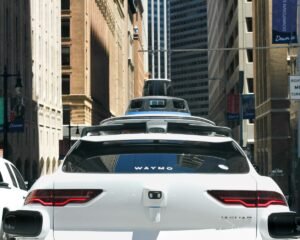
Just enough here to make the safety question make sense. A robotaxi stacks several senses on top of each other so no single blind spot can trip it up: cameras read traffic lights, signs and lane lines; lidar (spinning lasers) maps the exact shape and distance of everything around the car in 3D, day or night; radar tracks how fast things are moving and holds up in rain and fog; and a pre-built high-definition map means the car isn’t figuring out the street from scratch — it’s matching what it sees against a map it already knows. Onboard AI fuses all of it many times a second and makes the call: slow down, wait for the cyclist, take the gap. Tesla is the outlier here — it leans on cameras and AI and skips lidar, which is a big part of why its approach draws more debate than most. That overlap of sensors matters in a second, when we get to whether these cars are actually safe.
Are robotaxis actually safer than human drivers?
This is the question everyone actually wants answered, so let’s be careful with it — because the honest answer is “the early data looks genuinely encouraging, with real caveats.”
Most of the hard numbers come from Waymo, simply because it has driven the most miles with the public. According to Waymo’s own safety data, across more than 220 million fully driverless miles through March 2026, its cars were involved in about 94% fewer crashes causing serious or fatal injuries than human drivers would have been over the same roads, plus 82% fewer airbag-deployment crashes and 82% fewer injury crashes of any kind. Those are the company’s own figures — worth knowing, but a company grading its own homework.
The more reassuring part is that an independent group found a similar direction. The Insurance Institute for Highway Safety (IIHS), a research body funded by auto insurers, studied 50 million Waymo miles from 2021 to 2024 and found the cars were involved in far fewer crashes than human drivers — roughly 85% fewer single-vehicle crashes and 81% fewer injury crashes per mile.
But here’s the honesty the headlines usually leave out, and the IIHS researchers said it themselves: comparing robots to humans is genuinely hard. Around half of human crashes never get reported to police at all, which can make the human baseline look worse than reality. The study’s lead author put it bluntly — the current data-collection system just isn’t good enough to keep proving this as these fleets scale up massively. Encouraging signs, in other words, not a closed case.
Three more caveats are worth keeping in your head before you decide these things are simply “safe”:
- It’s mostly one company. The strong record largely belongs to Waymo. It doesn’t automatically transfer to Tesla, Aviari or anyone else — each system has to earn its own track record.
- Newer operators are largely unproven at this scale. That’s exactly why a Nevada commissioner flagged Tesla’s thinner commercial history. Being newly approved is not the same as being demonstrated-safe.
- They still have bad days. Regulators have opened investigations into driverless-car incidents, including a Waymo that struck a child near a school (minor injuries) and questions about how the cars handle stopped school buses. Waymo has also issued software recalls. Fewer crashes doesn’t mean zero.
What happens if the car gets confused — or crashes?
When a robotaxi hits something it doesn’t understand — an unusual road closure, a police officer waving traffic through by hand — it’s built to do the boring, safe thing: slow down, pull over, or stop and ask a remote human operator for guidance. That’s the good version. The frustrating version, which locals in robotaxi cities know well, is a car that “freezes” in the middle of the road because it isn’t sure what to do, and needs remote help to get moving again.
Crashes are where things get legally messy. In a normal wreck, you exchange details with another driver. Here, there’s no driver — so responsibility can land on the company, its software, or a maintenance failure instead of a person. That’s a big reason regulators are forcing these companies to log and report every incident: someone has to be accountable, and it can’t be the empty seat. (None of this is legal advice, by the way — just how the responsibility question is shaking out.)
Can a robotaxi be hacked?
It’s a fair worry: a car this connected is, in a sense, a computer on wheels. The realistic risk usually isn’t a movie-style villain seizing the steering remotely — these systems are heavily isolated and monitored. The more grounded concerns are the same ones haunting every connected device: the back-end systems, the app and the huge amount of data flowing back and forth.
If you want the bigger picture on how attackers go after connected tech, our explainer on what a zero-click attack is walks through how modern hacks often need no action from you at all — and it’s a useful frame for thinking about any “smart” vehicle.
The part nobody talks about: how much is it recording about you?
Here’s where a robotaxi stops being just a car and starts looking like something else. To drive itself, it films the world constantly — every pedestrian, license plate and storefront it rolls past. And many of these cars also have cameras pointing inward, at you.
This is the same tension we dug into with AI smart glasses: once a device has always-on cameras, the hardware is rarely the real story — what happens to the footage is. And on that front, robotaxis have already had one uncomfortable moment.
In 2025, researcher Jane Manchun Wong surfaced an unreleased draft of Waymo’s privacy policy, first reported by TechCrunch, which suggested interior-camera video — potentially tied to individual rider identities — could be used to train generative AI models, with an option to opt out. The draft also referenced sharing rider data to personalize ads.
To be fair to Waymo, it pushed back. The company has said it does not plan to use interior camera footage to identify individuals or to sell ads, and that the cameras exist for things like safety, cleanliness, finding lost items and handling emergencies. So this is an unresolved debate over a leaked draft — not a confirmed practice. But it opened a door that’s hard to close, because a few real questions remain no matter what any single policy says:
- Consent for people who never saw the app. You booked the ride and (maybe) skimmed the terms. Your kid, your friend who hopped in mid-trip, or a caregiver never agreed to anything — yet the cabin camera doesn’t know the difference.
- A cabin reveals a lot. Interior footage can capture faces, voices, who you travel with, a wheelchair or other mobility aid, and — through your pickups and drop-offs — sensitive places you’d rather not broadcast.
- Robotaxis as evidence. These cars are rolling witnesses. Their footage has already been sought in law-enforcement matters, which means a ride can quietly become a data source about you and everyone around the car.
None of this makes robotaxis uniquely evil — your phone already hoovers up a startling amount about you. But it does mean the smart question before you ride isn’t only “will this car crash?” It’s “what is it recording, where does that go, and can I opt out?”
Will robotaxis replace Uber and taxi drivers?
Eventually, in the cities where they operate, they could take a real bite out of driving jobs — that’s the whole business case, and it’s exactly why that Nevada commissioner raised the alarm about drivers’ livelihoods. But “eventually” is the key word. These fleets are still small, boxed into specific cities and service zones, and expensive to run. Human drivers aren’t going anywhere fast, and for a long while the two will simply share the road.
When will robotaxis be everywhere — and should you take one?
Realistically, robotaxis will spread city by city, not all at once. They need detailed maps, regulatory approval and predictable weather, so expect them to show up in more big, sunny metros first and reach smaller or snowier places much later. Las Vegas becoming a crowded testing ground is a sign of momentum, not a finish line.
Should you ride one if you get the chance? If a mature operator with a real track record is running in your city, the safety data so far is genuinely reassuring, and plenty of people find the rides smooth and oddly relaxing. Just go in clear-eyed: newer operators haven’t earned that trust yet, and whichever one you pick, you’re stepping into a car that’s watching the road — and quite possibly the back seat. Ride if you’re comfortable; just know what you’re getting into.
Frequently asked questions
Are robotaxis legal in the US right now?
In some places, yes. They’re approved city by city and state by state, not nationwide. As of August 2026, Nevada cleared Tesla, Waymo and Uber’s Aviari to charge for driverless rides in the Las Vegas area, where Zoox is already operating, and Waymo runs paid service in several other US cities. Most of the country still has no robotaxis at all.
Is there really nobody controlling the car?
There’s no driver in the seat and no one steering remotely moment-to-moment. The car drives itself. Companies do keep remote human operators who can give the car guidance if it gets stuck or confused, but they’re advisors for tricky situations, not invisible drivers steering from an office.
Can I turn off the camera inside a robotaxi?
Generally no — you can’t switch off the hardware. What you may get, depending on the company and your location, is a setting to opt out of certain uses of that data, like AI training. If cabin privacy matters to you, check the company’s current privacy policy and in-app settings before you ride, since these policies are still changing.
Would you get into a driverless cab with no one in the front seat — or does the idea still make you uneasy? And be honest: does knowing the car might be recording the back seat change your answer? Tell us in the comments — we read them.





One thought on “Are Robotaxis Safe? What to Know as Driverless Cabs Hit the Streets in 2026”